This week, we finally managed to install our new (not new ) item of furniture - a mid-18th Century grandfather clock. It's not bright and shiny like more modern ones, but a dark oak with a warm patina which the beeswax polish is drawing out. In order to set it up, we had to do a certain amount of research - how to hang the pendulum, where the weight went on the endless chain - and it got me thinking... where and when did certain divisions of time come from? The time periods which I have written either had household clocks or didn't, I have not written novels from the time of their invention. Clocks have been around for a long time, and the obsession with measuring time in an ordered fashion dates back to at least the ancient Sumerians. It was they who established a circular reading of time and, I imagine, the sixty seconds/minutes came about as much because it was an easy way to divide a circle as anything else. But it wasn't until much later that the precision of seconds ...

It's #HistFicThursdays again, and this week I'm thrilled to be sharing a Q&A post from award winning author, N.L. Holmes, as part of her Coffee Pot Book Club tour. Find out what research drew her into the world of Ancient Egypt, and the enduring appeal this time has for her...
Blurb
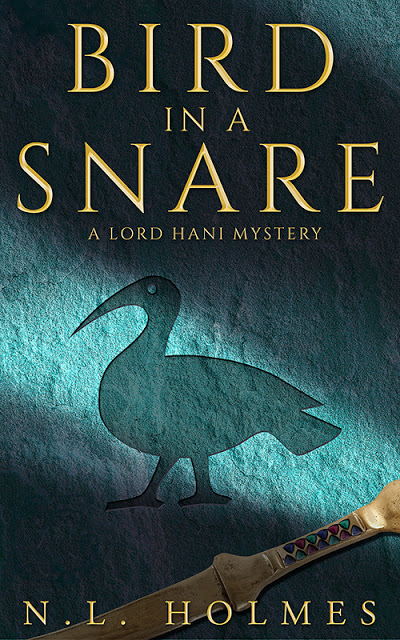
When Hani, an Egyptian diplomat under Akhenaten, is sent to investigate the murder of a useful bandit leader in Syria, he encounters corruption, tangled relationships, and yet more murder. His investigation is complicated by the new king’s religious reforms, which have struck Hani’s own family to the core. Hani’s mission is to amass enough evidence for his superiors to prosecute the wrongdoers despite the king’s protection—but not just every superior can be trusted. And maybe not even the king!
Winner of the 2020 Geoffrey Chaucer Award for historical fiction before 1750.
Bird in a Snare is available from Amazon UK - Amazon US - Amazon CA - Amazon AU - Barnes and Noble - Kobo - iBooks - Audio

Did you have a favourite resource for your research?
If so: what was it, and why?
I used so many research materials, I couldn’t point to one favorite. Perhaps you could say that Ancient Egyptian Literature, vol. II, translated by Miriam Lichtheim, was one of my most useful sources, because the titles of all the books are quotes from some piece of ancient literature—the Book of the Dead, a hymn, an aphorism. In the case of Bird in a Snare, the title comes from the Amarna Letters, an archive of diplomatic correspondences. The fictional Hani is a writer of aphorisms, and they’re all real—written by a guy named Ani, so I’ve conflated the two men. I had the advantage of a fair amount of general professional knowledge about this time and place because I had taught a course on Ancient Egypt for years, but there was a lot of refining of specifics, for example, details about a particular profession, that I needed to do. I think the real reason I moved from teaching to writing historical fiction is so I could continue to do research when I retired!
What is it about this time period which inspired you to set you book then?
I knew from my teaching experience that ancient Egypt has a lot of fans, and the period during and after the reign of Akhenaten is a particularly fascinating one. Many people know at least the names of the “heretic pharaoh” and his beautiful wife Nefertiti. The religious, economic and social changes introduced by this king are almost unimaginably disruptive, and I wanted to capture some of that impact on people’s everyday lives as well as on foreign policy. But it’s an interesting moment also for what we don’t know about it. Akhenaten was expunged from the historical record by his successors, so we didn’t even know he existed before the end of the nineteenth century, and we’re only just now starting to reconstruct events of his reign. We don’t even know who the kings are who follow him. Scholars are all over the place in their theories, and the author can thus pick her version of history and embroider at will, as long as she doesn’t transgress any of the facts we actually know for sure.
As historical fiction writers, we tend to imagine ourselves in the time we’re writing.
If you could go back to this time period, what do you imagine yourself doing?
Realistically speaking, I’d probably be a “lady of the house” like most women. But since I’m a working-class kind of gal, I’d like to be some sort of creative artisan like Maya’s mother, a goldsmith. I actually did silver-smithing when I was a teenager! Or maybe a seshet, a female scribe, unusual though that would be. Hani’s daughter Neferet learns to read and write, but she becomes a doctor, and I’m not sure that’s up my alley. The fact is, Egypt was one of the better places to be a woman in antiquity. They had more or less equal rights and could divorce if they found themselves in a bad marriage. Maybe I’d become the head “man” of my village—that really happened sometimes.
Now, let's meet the author:
.jpeg)
N.L. Holmes is the pen name of a professional archaeologist who received her doctorate from Bryn Mawr College. She has excavated in Greece and in Israel and taught ancient history and humanities at the university level for many years. She has always had a passion for books, and in childhood, she and her cousin (also a writer today) used to write stories for fun.
You can follow N.L. Holmes on these links:

Thank you so much for hosting the blog tour for Bird in a Snare.
ReplyDeleteAll the best,
Mary Anne
The Coffee Pot Book Club
You're very welcome!
Delete📚